

The Modern Human Solution
You're not going to like it.

In the last post, we explored the Modern Human Tragedy. So let’s briefly summarise that.
The tragedy is that our desires (and other emotions) are mainly generated by our limbic system. The limbic system is millions of years old, and evolved in a world that is very different from ours. In that world, the demands of the limbic system made sense, and were vital for meeting our needs long enough to be able to procreate. It shouted:
Get all the calories all the time and don’t exert yourself!
Climb the tribal hierarchy!
Be scared of anything new!
And this all made sense when food was scarce, survival depended on tribal membership, and new things were almost certainly going to kill you. These emotions were the signals that kept our ancestors alive and breeding.
But our ancestors also had a clever bit of brain called the cerebral cortex, which rebuilt the environment so we could meet these needs much more easily. The limbic system continues to send its emotions up to the conscious brain regardless of that, though; it’s just not that sophisticated. We’re now in the position where, much of the time, these emotions — these messages — can do more harm than good. We can easily get fat and lazy, become desperate for validation, and be scared of anything new (including, perhaps, the ideas in this post).
The Modern Human Tragedy is that our desires are incompatible with our world, and that is our cross to bear. To compound the issue, much of the world – with its religions, advertising and social media – is designed to amplify the limbic system’s signals so that we want to do things that benefit others more than ourselves.
So that’s the problem; what exactly is the solution?
Well, you’re probably not going to like it as, unsurprisingly, is means not getting what you want. But trust me when I promise that that is nowhere near as bad as it seems, and we will cover that in a later post. But, for now, we’re going to need…
Discipline
Ok, discipline. This gets such a bad rap in modern culture, and that’s harmful.
We understand discipline well enough when it comes to work. We have to be at work on time, do what we’re paid to do and not arse around. Makes sense, right? They’re paying us and they deserve to get the best out of us.
But why shouldn’t you get the best out of yourself too? The reasons that make discipline important at work don’t just disappear when nobody’s paying you. To get quality in this life, you have to make it, and that’s not something your limbic system is going to nag you about.
But the limbic system is an idiot, and you shouldn’t let it take the reins.
The key thing with discipline is understanding what to do with it. You are absolutely not required to flog your guts out at home; I certainly don’t. In fact, discipline is important in this noisy world for getting enough rest and having peaceful, focused minds.
It’s also important for building sensible routines, sticking to plans and not worrying about things that don’t deserve our mental energy.
Discipline makes life easier, not harder. It’s just that we find that difficult to conceptualise; we can’t understand why not getting what we want would be easier than getting it. But discipline is crucial for fulfillment, as is…
Knowing Yourself
In order to know the difference between harmful desires and real needs, we have to start with recognising that our needs are defined by our human nature. If you’re not familiar with Maslow’s Hierarchy of Needs, this should be the first thing you should understand.
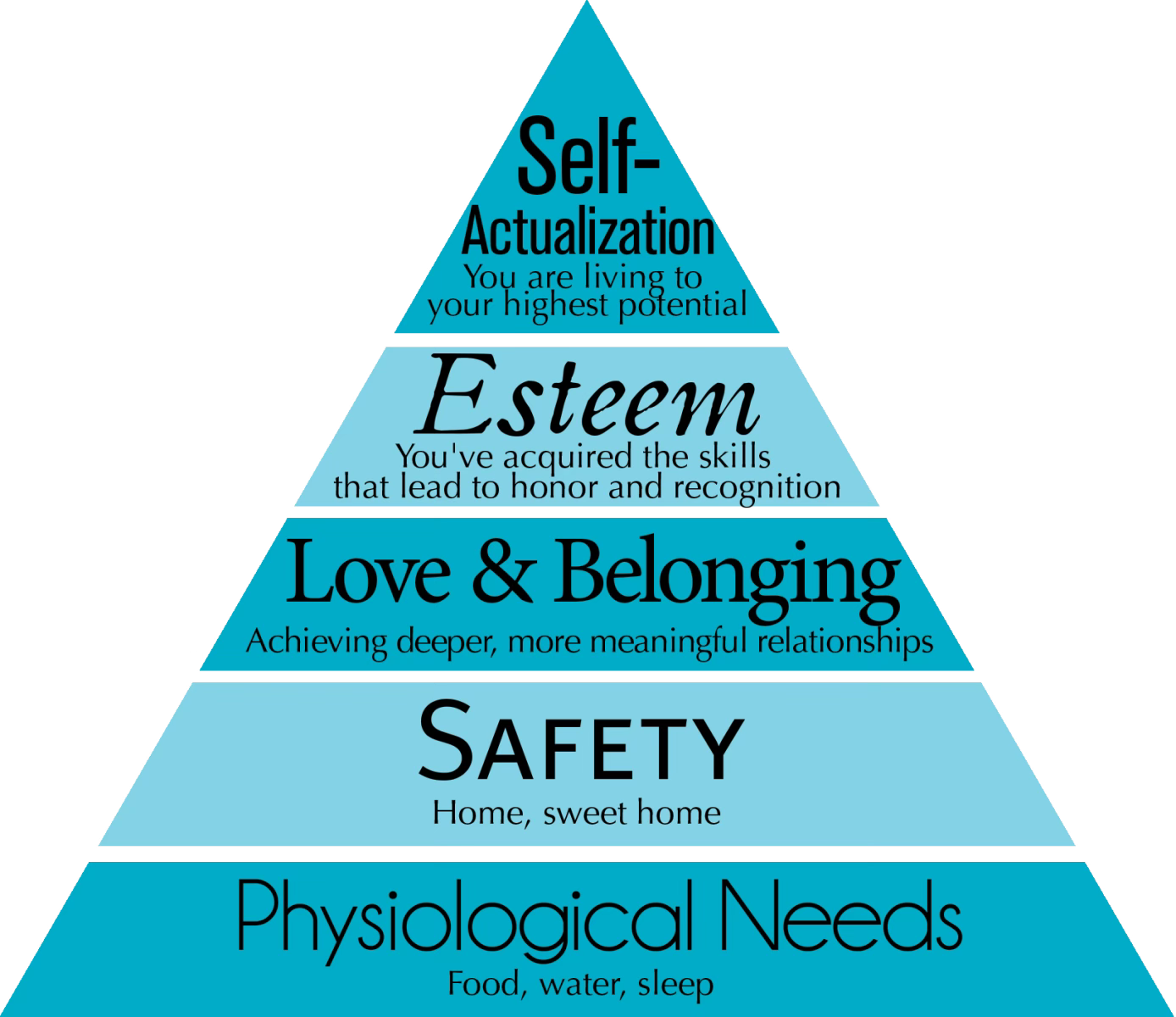
This simple diagram shows, in order, what we need to be fulfilled. Humans are normally motivated to fulfill the Physiological Needs of the bottom layer before they try to fulfill their Safety Needs, and onwards up the pyramid we go.
Maslow predicted that only 2% of the population could achieve Self-Actualisation, but don’t let that put you off. Thinking about all this and strategically working towards it will make it much, much easier. The vast majority of people will never bother to do that.
The Maslow Trap
But be careful. It is entirely possible that you are already meeting many of the needs on the pyramid, while being tricked into feeling otherwise.
This is because of how the human mind works, and the way it creates associations between things.
Let’s imagine an advert for, say, a celebrity fragrance. I think we can agree that, rationally, paying £80 for a small bottle of perfume or aftershave is insane. There simply isn’t anywhere near that amount of utility in smelling nice.
But it’s not really about smelling nice, is it? The marketing and the adverts aren’t really selling a nice smell. These promotions invariably feature A-list celebrities who smell the same as everyone else. The difference between them and us, of course, is that they are extremely famous in the global tribe. They have status we could never realistically hope to attain.
And that’s what we think we’re buying when we hand over our hard-earned for a fancy bottle of chemicals. We’re willingly buying into the delusion that we will raise our status by owning this scent, and smelling like we own this scent. We associate the fragrance with status, and so confuse one with the other. That’s why we pay so much for it.
Not only does this not really work, in that most people don’t care what you smell like, — as long as it’s not shit — but, even if you are perceived to be higher in status, it is unlikely to have any material effect on your life.
And when you do climb to a higher position (if you do), you will be just as dissatisfied, because your expectations will adjust to your new status. There’s a reason why rich and famous people rarely give up coveting wealth and fame, after all. Their expectations are set, as are ours, by their station in life.
Now… there can be good, strategic reasons for increasing our status, but they rarely feel as compelling as the limbic “reasons”. The fact of the matter is, we feel like we want to climb the social ladder because, for most of our evolutionary history, our survival and reproduction depended on it. Being near the bottom of the tribe meant living with the risk of exile; it felt important because it was important.
These days, though, it is never that important and rarely important at all. Our status in the tribe is assured by our birth certificates, national insurance numbers and our human rights. Civilisation has deemed it important to protect your status.
But nothing can stop your limbic system crowing about it anyway.
So, with Maslow, it’s really important to objectively and rationally understand if our needs are being met, even when it feels like they aren’t. Because there is a crucial difference between wants and needs:
Unmet needs are the source of real problems; wants are imposters masquerading as needs.
And that’s why we have to understand our real needs, and why we need the discipline to reject our desires when it’s beneficial to do so.
Values
It’s all very well understanding our needs, defined as they are by our humanity, but we’re all different too.
And that’s where values come in. Our values give us extra detail about what we, as individuals, need from our relationships, and what we need to be recognised for etc. We’ll cover values in more detail in another post, and I’ve written about all of this in detail in my guide, Work, Reward & The Good Life, too.
But the point is that, in order to meet your needs precisely, you have to be aware of your own values.
And That’s (Almost) All There Is To It
This post provides a very high-level overview of the solution to the Modern Human Tragedy, and it really only serves as the starting point.
In order to navigate the 21st Century, we’re going to have to explore these ideas in more detail. Much of that is down to you. As with all of my posts, you have to think about all of this yourself. Take time over it; reject my ideas if you find that you should, but take the time to mull them over properly too.
We will also need to explore the nature of the outside world, as well as understand the many challenges that come from within. We will do all of this in future posts.
But for now, it would be great to read your thoughts about this post in the comments
And, until next time, I wish you happy thinking!
Matt